

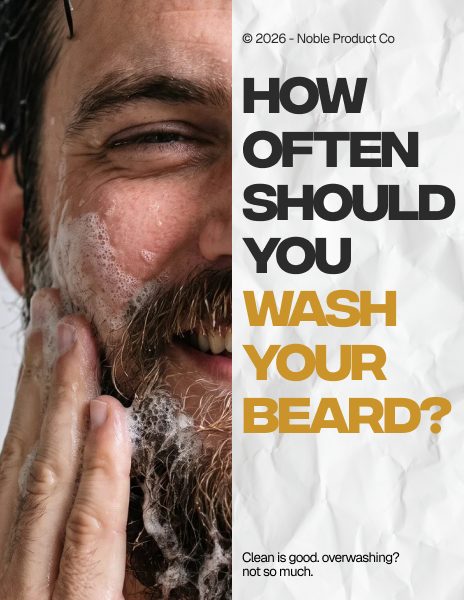
How Often Should You Wash Your Beard?
Wash your beard when it is dirty. That is the real answer, and it depends on your day rather than a number on a calendar. If you sweat through a shift, worked outside, or hit the gym, wash it. If you did none of that, a warm water rinse is usually enough. The rule that matters more than frequency is this one: if you wash, you condition. Every time, no exceptions.
How often should you wash your beard?
As often as it actually gets dirty. Shampoo is not the enemy, and it is not something to ration. It exists to get dirt out, so the only real question is whether you have dirt.
A guy on a job site and a guy at a desk do not have the same beard at the end of the day. Most people land somewhere between two and four washes a week, but that number is a result, not a rule. Read the beard instead. Heavy, dull, or smelling like your day means wash it. Clean and comfortable means a rinse will do.
The advice to strictly limit washing comes from a real place, which is that washing without conditioning leaves a beard worse off. The fix for that is conditioning, not avoiding soap.
Why do you have to condition every time you wash?
Because washing takes the natural oils off your skin and hair, and those oils are what protect you from wind, cold, and everything else you walk through during the day.
Strip them out and put nothing back and you have left your beard more exposed than it was before you started. That is the actual cause of most of the dryness and itch people blame on washing. It is not the wash. It is the missing second half of the wash.
Conditioner smooths the hair, cuts tangles, and puts moisture back where the wash took it from. Our Beard Wash and Conditioner is built as a pair for exactly this reason.
Do you need to wash out beard butter and beard oil?
Yes, and this is the part most guys miss. Beard butter and beard oil pull dirt and dust out of the air all day long. That is not a flaw, that is the job working correctly. But it has to come back out, or it stacks up on your skin.
If you use product daily, you need to wash more often than someone who uses nothing. Skipping washes to protect your beard while layering product on it every morning gets you buildup, not health.
Should you use shampoo or a beard wash?
Use a beard wash. Regular hair shampoo is built to cut oil hard, because a scalp produces plenty of it. Your face does not. Run scalp-strength shampoo on coarse beard hair and you get rough, brittle, and dry.
A dedicated beard wash lifts dirt and buildup without going scorched earth on everything else. And go easy. Use less than you think, and stop scrubbing your face like it is the top of your head.
Hot water or warm water?
Warm. Hot water pulls oil out fast and irritates the skin under a thick beard. Warm water opens things up enough to rinse buildup away without taking everything with it. A cooler rinse at the end helps the hair lie flat if you want it.
How do you dry your beard without damaging it?
Pat, do not scrub. Rubbing a towel back and forth roughs up the outer layer of each hair and you end up with frizz. Press the towel in to soak up the water, then leave the beard slightly damp.
Damp is the right moment for everything that comes next. Work beard butter down to the skin first, then seal it with a few drops of beard oil pulled out to the ends.
Will washing right make your beard grow?
No, and it is worth being straight about that. Washing and conditioning correctly changes how your beard feels and looks. It does not change how much of it there is.
You cannot grow hair where there is no hair. The only thing that moves the needle on dormant follicles or fine vellus hair is prescription medication, and it works exactly as long as you keep taking it. What a good routine does is help what is already on your face become the best version of itself. Conditioned hair breaks less, lies flatter, and reads as considerably fuller. That is a real result, and it is the one anyone selling you a growth oil should be promising instead.

Leave a comment
This site is protected by hCaptcha and the hCaptcha Privacy Policy and Terms of Service apply.